Total: €0,00
Taxes and shipping calculated at checkout

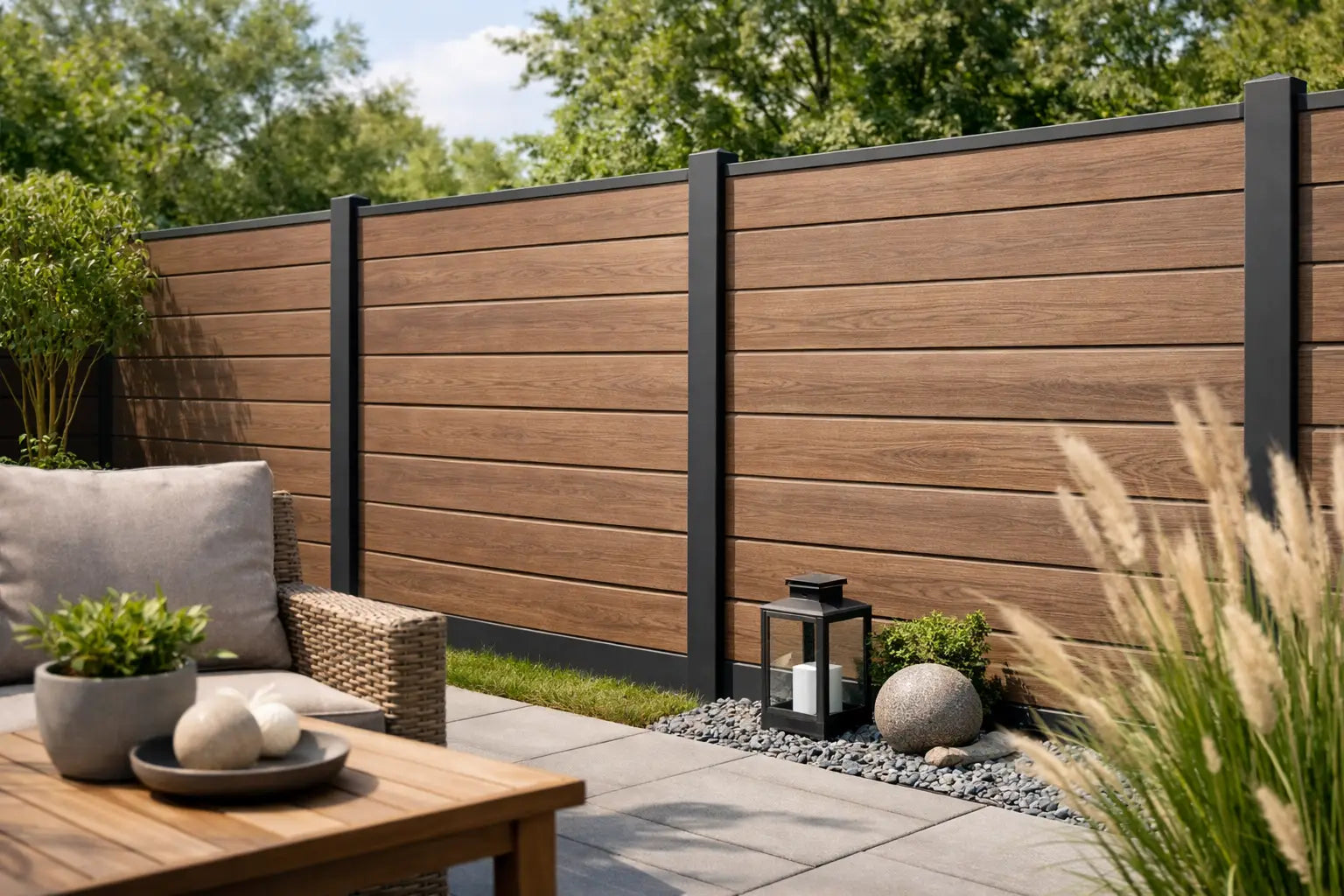
Even the most perfectly landscaped garden can fall short of its full potential with a weathered wooden fence. This is precisely why more and more people are choosing a composite fence with a wood look: the warm appearance of wood, without the annual sanding, staining, and replacement of damaged parts.
For homeowners, it's primarily a matter of convenience and aesthetics. For gardeners, contractors, and installation companies, it's equally about supply reliability, consistent quality, and a system that can be processed neatly and predictably. A good fence shouldn't just look good on day one, but should also remain sharp after years outdoors.
Its appeal is easy to explain. Wood has character, but requires maintenance and reacts strongly to weather, moisture, and sun. Composite offers a similar look, but is developed for long-term outdoor use with much less maintenance. This makes it attractive to anyone who wants a modern, sustainable garden without recurring maintenance burdens.
Furthermore, the finish is often calmer and more consistent than with traditional wood. No large color differences between planks, less chance of cracks, and cleaner lines. Especially for new build homes, modern gardens, and renovation projects, this aligns better with the desired aesthetic.
The wood look plays a big role in this. Many people don't want a cold, plastic look in their garden. They seek warmth, natural tones, and a material that visually matches paving, facades, awnings, and outdoor lighting. This is precisely where the strength of composite with wood grain or wood structure lies.
Not every composite fence is the same. This is reflected in color, surface, composition, and installation method. Those who only look at the photo risk choosing a system that in practice is less suitable for the garden or project.
A wood look works best when the color matches the surroundings. Warm brown tones give a natural, classic look. Grey-brown or anthracite-like wood looks appear more modern and combine strongly with black details, aluminum frames, and sleek patio tiles.
Therefore, don't just look at the fence itself, but at the whole. Consider the color of the facade, the paving, the veranda, and any planters. In a compact city garden, a too dark fence can seem heavy, while a too light shade in a modern setting can quickly look bland.
Some panels have a clear wood grain, while others have a subtle brushed surface. This difference seems small, but strongly determines how natural the fence looks. A pronounced grain gives more character. A calmer surface is better suited for minimalist gardens and commercial projects.
Again, it depends on the application. In a rural garden, the wood look can be a bit more pronounced. For a sleek terraced house or a project-based installation, a uniform, calm finish is often the better choice.
A fence is more than a collection of planks. Posts, profiles, fasteners, and capping determine how neat the end result will be. Complete systems usually ensure a neater installation and less improvisation on site.
For professionals, this is important because installation time directly affects profit margins. For DIY enthusiasts, it mainly means less hassle and less chance of errors. A smartly constructed system works faster, looks neater, and delivers a more consistent result.
Anyone who has ever had a wooden fence knows how quickly it begins. First some discoloration, then green growth, then cracks or warping parts. Then comes the question of whether to treat it one more time or just replace it.
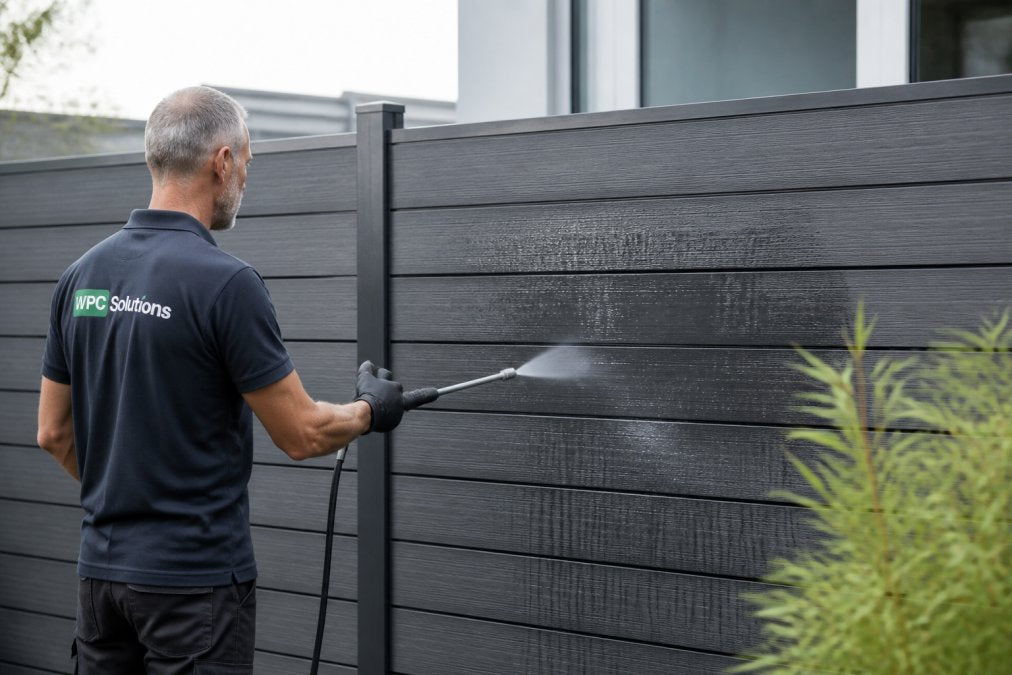
With a composite fence with a wood look, it's different. The material is designed to perform strongly outdoors without intensive maintenance. Cleaning with water and a soft cleaning agent is usually sufficient to keep the fence tidy. That saves time, costs, and frustration.
This low-maintenance character is not only pleasant for private individuals. It is also a big plus for commercial applications, rental properties, new build projects, and gardens that need to remain presentable immediately. You install something that will look well-maintained for years without recurring painting or staining.
A fence stands outdoors day and night. Rain, frost, bright sun, and temperature fluctuations demand a lot from the material. This is precisely why composite is often chosen as an alternative to traditional wood.
The added value lies in the combination of dimensional stability, color stability, and resistance to moisture. This does not mean that nothing ever changes - every outdoor material ages visually to some extent - but it does mean that the fence generally remains neat and usable for much longer without structural problems such as rot or splitting.
This makes the investment more interesting in the long run. The purchase price may be higher than with simple wood, but the total costs over several years often turn out to be more favorable. Less maintenance, less replacement, and a consistently neat appearance make the difference.
Virtually anywhere where appearance and convenience need to come together. In private gardens, it is a logical choice for property boundaries, privacy walls, and modern garden layouts. Especially for people who want a luxurious look, but not a material that requires attention every season.
For professionals, it is equally interesting in serial construction, renovation, and custom projects. A composite system is attractive when speed, neat finish, and predictable quality are heavily weighted. Because colors and profiles are consistent, it is also easier to work towards a uniform end result.
It also works strongly in combination with other applications. Think of the same style in fencing, facade cladding, decking, or wall finishing. This creates tranquility in the design and immediately makes a project appear more thoughtful and valuable.
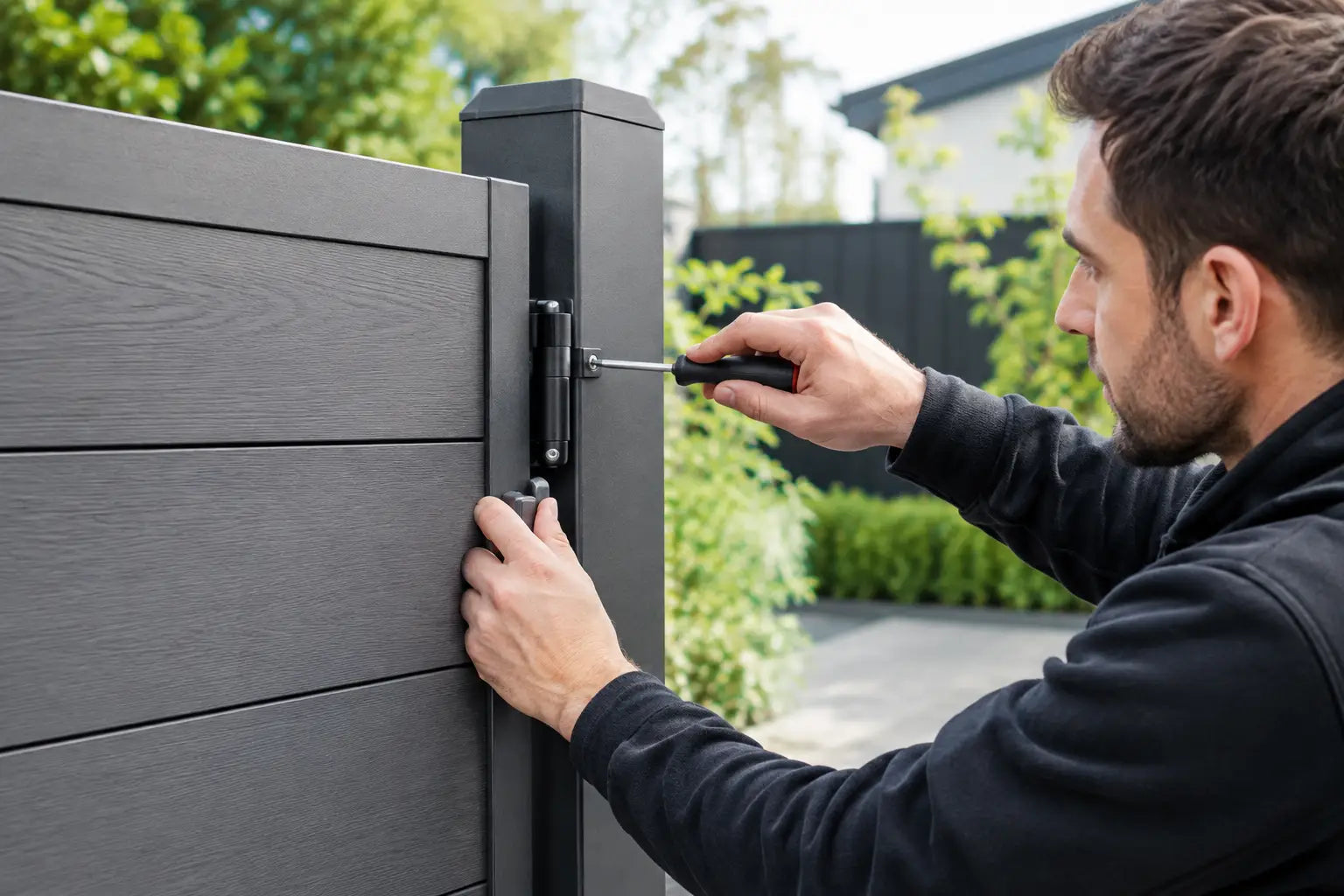
That depends on experience, tools, and the complexity of the situation. A straight fence on a well-prepared surface is perfectly doable for many handy DIY enthusiasts, especially when the system is logically constructed. Accurate measuring and working with a spirit level remain crucial.
For differences in height, corner solutions, non-standard dimensions, or larger projects, professional installation is often the wisest choice. Not because it is necessarily difficult, but because a small deviation in the base will later remain visible in the entire line pattern.
For professionals, processing speed also counts. Materials that are delivered complete and clearly save time on the construction site. This is precisely why complete system solutions are so popular: less searching, fewer individual choices, and a faster path to a neat result.
A fair comparison is appropriate. Solid wood has its own charm that is irreplaceable for some people. Those who appreciate natural graying, knots, irregular patterns, and a more organic look can still consciously choose wood.
Even with very low budgets, wood sometimes seems more attractive to purchase. However, you then have to factor in maintenance, a shorter lifespan, and possibly earlier replacement. Cheap at purchase is not automatically economical in the long run.
For most people looking for a modern, low-maintenance, and durable garden enclosure, the balance is now clearly shifting towards composite. Especially if appearance and convenience are equally important.
You don't buy a good fence based solely on price per plank. Look at color fastness, system construction, finishing level, availability, and how well it fits your home or project. This prevents a fence from seeming interesting on paper but not delivering the desired result in practice.
Those who want to act quickly also benefit from a supplier who offers complete solutions instead of just loose parts. This simplifies comparison and speeds up the process from selection to installation. WPC Solutions strongly capitalizes on this with low-maintenance systems designed for a sleek finish and long-term outdoor use.
Ultimately, a composite fence with a wood look is primarily a choice for peace of mind. Peace of mind in maintenance, peace of mind in appearance, and peace of mind knowing that your garden or project will still look well-maintained in a few years.