Total: €0,00
Taxes and shipping calculated at checkout

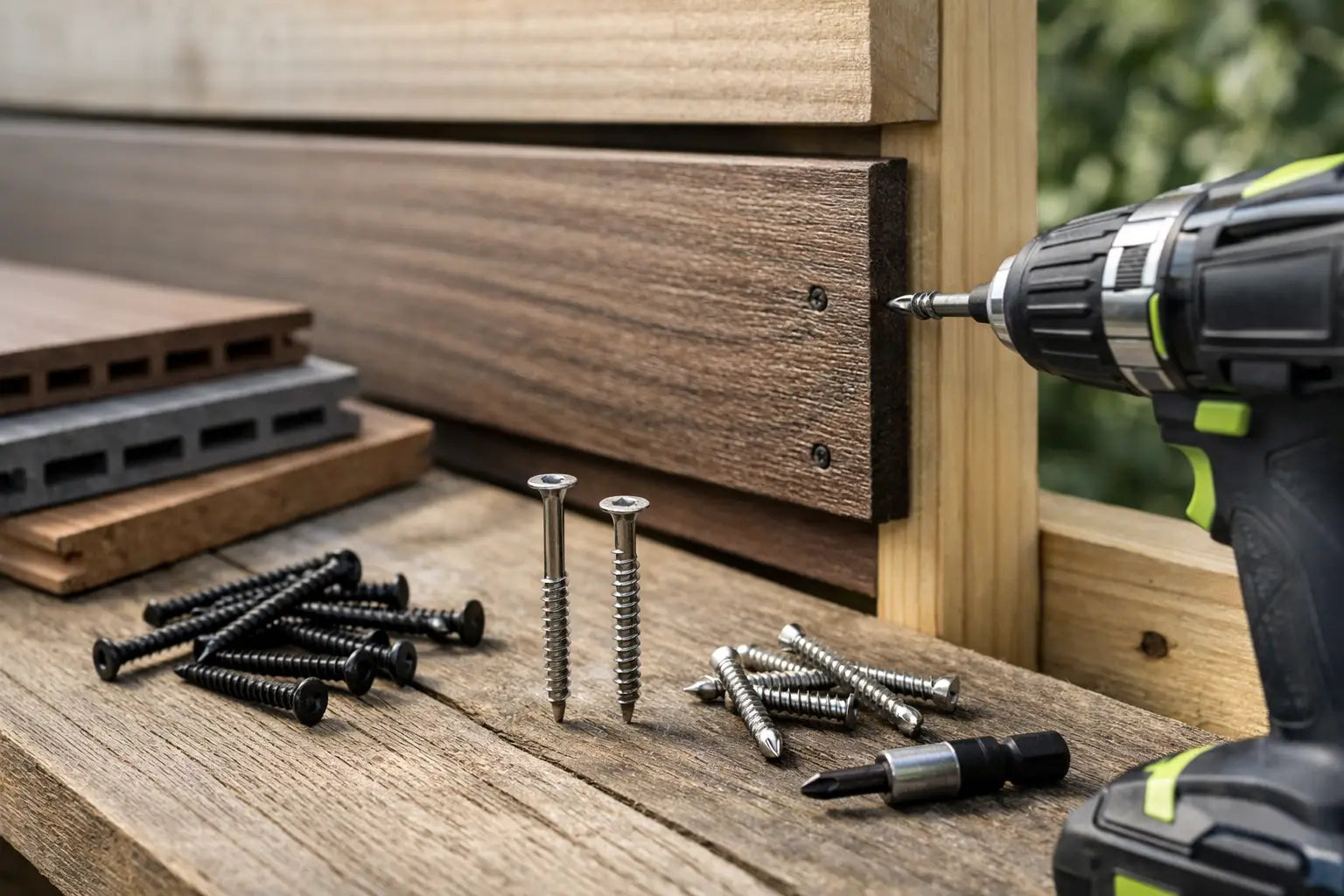
A tongue-and-groove facade stands or falls on the details. Even high-quality composite tongue-and-groove panels can look less sleek when screw heads rust, panels bulge, or fasteners are overtightened. Those looking for which screws are suitable for tongue-and-groove panels therefore need more than just a random stainless steel screw. The material, length, substructure, and installation technique must all be compatible.
For a low-maintenance facade with a modern wood look, choose a fastening system that will perform well for years. This prevents discoloration, visible rust streaks, and unnecessary repair work – precisely the benefits that composite cladding should offer.
For composite tongue-and-groove panels, a stainless steel screw is generally the right base. Stainless steel prevents moisture, rain, and temperature fluctuations from affecting the fastening. Preferably choose screws with a small head, especially when you are installing the screws visibly in the tongue-and-groove panel. A smaller head provides a calmer facade appearance and reduces the chance of the material around the screw being put under tension.
For a normal exterior facade, garden wall, or canopy, stainless steel A2 screws, often referred to as 304 stainless steel in the US, are usually sufficient. Is the facade located on the coast, near a swimming pool, or in an environment with a lot of salt, chlorine, or industrial pollution? Then choose stainless steel A4, comparable to 316 stainless steel. This material offers extra protection against corrosion and is the safer investment in locations where standard stainless steel can corrode more quickly.
Avoid galvanized screws, ordinary steel screws, and unknown screws with only a decorative coating. These may seem fine in the short term, but a facade is exposed to rain, UV radiation, and condensation for years. As soon as the protective layer is damaged, rust formation and dark streaks can become visible on your tongue-and-groove panels.
A screw must not only go through the tongue-and-groove panel but also get sufficient grip in the underlying batten. When mounting on wooden battens, a penetration depth of at least approximately 1 to 1.25 inches into the wood is a practical starting point. The total length therefore depends on the thickness of your tongue-and-groove panel, any mounting clip, and the thickness of the batten.
For many tongue-and-groove panels, you will end up with a screw of approximately 1.5 to 2 inches. In metric sizes, this is often 4.0 x 40 mm or 4.0 x 50 mm. A screw that is too short provides insufficient grip, especially under wind loads or with panels that work slightly due to heat and cold. An unnecessarily long screw can, conversely, protrude through the batten or hit vulnerable pipes behind the structure.
Are you mounting on aluminum battens? Then use screws specifically designed for metal or aluminum. A self-drilling screw can speed up assembly but must match the wall thickness of the profile. With aluminum, material compatibility is also relevant: incorrect metal combinations can cause corrosion under humid conditions. Therefore, always follow the fastening guidelines of the chosen facade system.
The sleekest finish is often achieved with a concealed fastening system. Many composite tongue-and-groove panels are designed with a groove, tongue, or click connection in which clips or special mounting points are incorporated. The screw is then out of sight, while the panel retains space to move in a controlled manner. This creates a uniform facade without visible fastening points.
Visible screwing is sometimes the right solution. Consider a trim board, an edge detail, a part that cannot be secured with clips, or an application where extra mechanical fixation is needed. In such cases, choose stainless steel screws in a color that matches the tongue-and-groove panel, such as black, anthracite, or brown. Ensure that it is a durable coating suitable for outdoor use.
For visible mounting, the position is crucial. Do not screw too close to an edge and place the screw in a spot that sufficiently supports the profile. A screw in a thin lip, in the overlap, or right next to an end can cause cracking, deformation, or a less tight connection.
Composite is stable and low-maintenance, but it is not solid wood. Due to sun and temperature differences, the material can expand and contract to a limited extent. If a screw is overtightened, this natural movement is blocked. This can cause parts to bulge, screw heads to pull visibly deeper into the surface, and tension to arise around the fastening.
Therefore, tighten the screw until the head fits snugly, without pressing into the tongue-and-groove panel. For systems with pre-drilled slotted holes, the screw should often be placed in the middle of the slot. This allows the profile to continue to move lengthwise without the fastening coming loose.
Pre-drilling is advisable for many composite profiles, especially close to the ends and for visible screw mounting. It prevents the material from splitting or bulging under pressure. Use a drill bit that matches the prescribed screw diameter and work slowly. Drilling too quickly can build up heat and make the drilled edge less neat.
The best screw will not solve an installation problem if the substructure is insufficiently ventilated. Air must be able to circulate behind cladding so that moisture can dry out. This protects both the back wall and the battens and helps to keep the tongue-and-groove panels flat.
Therefore, mount tongue-and-groove panels on a straight, sturdy batten structure with sufficient distance from the back wall. Leave space at the bottom and top of the facade for air intake and exhaust, but shield the openings if insects or dirt could be a problem. Also ensure that water does not remain on horizontal edges. A well-designed start and end profile makes a visible difference here.
For a facade facing a sunny direction, extra attention is needed for expansion space at the ends. Dark colors absorb more heat than light shades. Measure the required joint according to the product instructions and do not simply use the same distance as for wooden tongue-and-groove panels.
The most common mistake is choosing based on price instead of application. A cheap screw saves little if you have to repair rust spots after a few seasons. Incorrect length, too few fastening points, or a crooked substructure also cause problems that are already visible from the street.
A second mistake is mixing systems. Clips, screws, tongue-and-groove panels, and trim profiles are often designed to function together. A universal clip or screw may coincidentally fit, but it does not automatically provide the correct space, load-bearing capacity, or alignment. For a sleek result, a complete system is usually the most efficient choice.
Finally, expansion joints are often forgotten. Mounting panels tightly against each other, against a corner profile, or against a window frame seems neat on the day of installation. However, when the temperature changes, the space the material needs is missing. Always adhere to the prescribed expansion space.
Are you mounting composite tongue-and-groove panels on a standard wooden framework in a sheltered garden or on a house facade? Then typically choose a stainless steel A2 screw of the prescribed length, combined with the corresponding clip system. For visible work, choose a small head in a matching color.
Is your project on the coast, next to a swimming pool, or in another location with a lot of moisture and aggressive substances? Go directly for stainless steel A4. The extra cost is small compared to the lifespan of your facade. If you are working with aluminum battens, adjust the screw to the profile thickness and use only fasteners suitable for that combination.
WPC Solutions offers complete composite solutions where tongue-and-groove panels, profiles, and mounting materials are perfectly matched. This makes it easier to build a facade that not only looks modern upon completion but also remains sleek after years of sun, rain, and temperature differences.
Before ordering, always measure the thickness of the tongue-and-groove panel, the material of the batten structure, and the desired finish. With the right stainless steel screw, sufficient ventilation, and room for movement, you build a facade that combines the appearance of wood with the ease of composite.