Total: €0,00
Taxes and shipping calculated at checkout

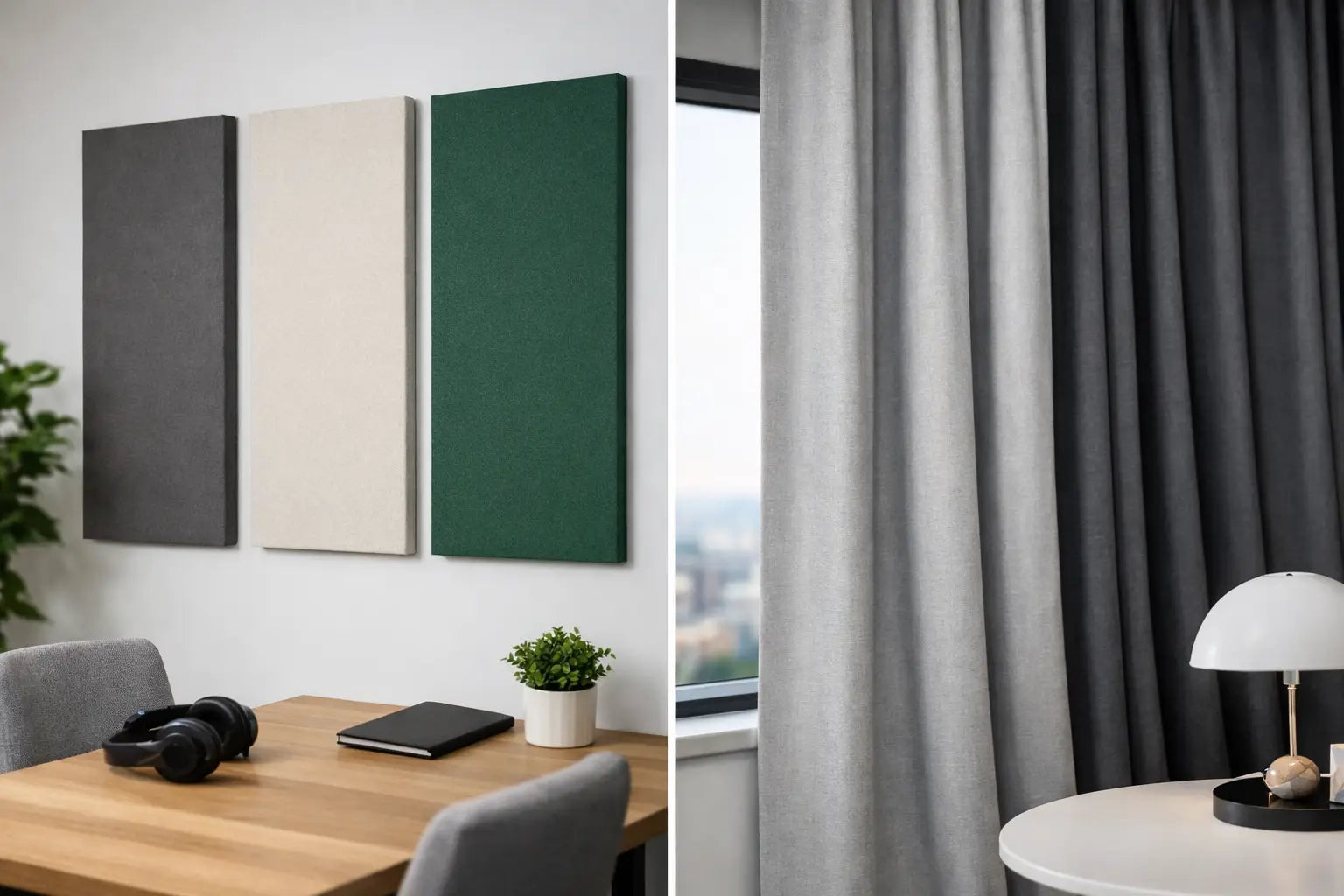
A room can look sleek and luxurious but sound restless. Consider a living room with a hard floor, large windows, and a modern dining table: conversations bounce around the room, and the TV volume constantly needs to be turned up. Therefore, when choosing between acoustic panels or curtains, it's not just about taste. It's about understanding the source of the reverberation, the expected effect, and which finish suits your home or project.
Curtains can soften sound, especially around large glass areas. Acoustic wall panels tackle the problem more directly and immediately add depth and character to a wall. The best choice depends on the space, existing materials, and desired aesthetic. Choosing wisely creates noticeably more tranquility without sacrificing a modern interior.
Many people expect that a soft wall finish will block all outside noise. That's not what acoustic panels or curtains do in most homes. They primarily improve the acoustics within the room: they absorb some of the sound waves that would otherwise continue to reflect off glass, stucco, concrete, tiled floors, and hard furniture.
You'll notice the difference when making calls, working, dining with guests, or watching television. Words become more intelligible, and the room sounds less hollow. If you truly want to limit sound transmission to neighbors or between floors, a constructive solution is needed, such as additional insulation in the wall, ceiling, or floor. Wall panels and curtains are then a valuable addition but not a replacement for sound insulation.
Curtains are often the first step in rooms with a lot of glass. This makes sense: windows are hard, reflective surfaces and simultaneously require privacy and light control. A heavy fabric with a lining absorbs more sound than a thin, translucent curtain. The installation also makes a difference. Curtains that run from near the ceiling to just above the floor and are generously pleated have more fabric surface to absorb sound.
In a bedroom, living room, or apartment with large sliding doors, good curtains can noticeably soften the acoustics. They primarily break the sharp reflections near the window and make a minimalist interior feel warmer. Moreover, you can open them when you want maximum daylight. This flexible character is an advantage that fixed wall panels do not offer.
There's a trade-off, however. Curtains only work on the surface they cover. For a large part of the day, window treatments may be open, reducing their acoustic effectiveness. In a room where reverberation primarily occurs between a long bare wall, a ceiling, and a hard floor, a curtain by the window will not fully resolve the core problem.
Maintenance also plays a role. Textiles attract dust and need to be cleaned periodically. For households with pets, allergies, or a busy family life, this can be a practical consideration. Therefore, don't just choose based on color or blackout properties, but also on fabric weight, washability, and the degree of drape.
Acoustic wall panels are designed to functionally and visually improve a hard, bare wall. The slatted structure with a sound-absorbing backing helps to reduce reflections in the room. This can make a big difference, especially for mid- and high-range tones, such as voices, cutlery, children playing, and television sound.
The strength of panels lies in their targeted placement. You treat precisely the wall where sound reflects, for example, behind the dining table, in the seating area, in a home office, or on the wall behind the bed. This makes them suitable for spaces where curtains are not practical, such as a hallway, mezzanine, study, or open kitchen. Moreover, an acoustic panel is always active: you don't need to close anything to experience its effect.
The aesthetic is a second important reason to choose panels. A wood-look slatted wall provides a calm, modern base and makes a room feel less flat. A full accent wall creates a powerful interior statement. A narrower section or a few panels can be enough to define a seating area without making the room dark.
For DIY enthusiasts and professionals, the predictability is appealing. Panels have a fixed size, consistent color, and sleek lines. With good preparation, they can be easily mounted on a flat surface or framework. At WPC Solutions, this modern aesthetic aligns with a product range designed for a low-maintenance, neat finish.
The choice becomes simpler when you look not only at the purchase price but also at function, placement, appearance, and maintenance. Curtains and panels are not direct copies of each other.
| Component | Curtains | Acoustic Wall Panels |
|---|---|---|
| Best Application | Large windows, privacy, and light control | Bare walls, seating areas, offices, and dining areas |
| Acoustic Effect | Softer sound around the window, depending on fabric and pleats | Targeted absorption on the treated wall |
| Appearance | Warm, soft, and changeable | Sleek, modern, and architectural |
| Maintenance | Vacuuming and periodic cleaning | Regular dusting is usually sufficient |
| Flexibility | Open, close, or replace | Permanent finish with lasting effect |
Those primarily looking to soften a hard glass wall often wisely choose quality curtains. Those wanting to utilize an empty wall and seeking long-term better acoustics generally have more control over the result with panels. In many interiors, the combination is even stronger: heavy curtains at the windows and acoustic panels on the most important reflective wall.
Covering an entire room blindly is rarely necessary. The correct position usually yields more than adding as much material as possible. Start by listening. Clap your hands once while standing in different spots in the room. If you hear a long, clear echo, look for the largest hard surfaces opposite each other.
In a living room, the wall behind the sofa, behind the television, or next to the dining table is often a good candidate. In a home office, a panel behind or next to the desk works well because voice sound reflects directly there. For a mezzanine or high-ceilinged room, wall panels can help, but don't expect a miracle cure if the ceiling, floor, and multiple walls remain completely hard. In such cases, a combination with a rug, upholstered furniture, or window coverings may be necessary.
Also, pay attention to proportion. A small strip of panels on a huge, open wall primarily has a decorative effect. A wider panel surface, tailored to the seating area or dining table, usually works more convincingly in terms of visuals and acoustics. Samples are practical here: you can assess color and wood look under your own daylight before ordering a larger area.
A dark wood look immediately adds contrast to a large interior but can visually shrink a compact room. Light oak or sand tones keep a room open and combine easily with white walls, natural stone, and neutral floors. Black felt between the slats emphasizes depth and suits an industrial or modern style; a softer color scheme looks calmer in a bedroom or Scandinavian interior.
Additionally, consider daily wear and tear. In a busy family space, you want a finish that stays looking neat without time-consuming maintenance. In a rental property, a solution with limited, neat installation may be more attractive than a permanent renovation. For a professional application, such as a reception area, showroom, or office, the overall impression also counts: panels introduce repetition and rhythm into long walls where loose decoration often looks messy.
Choose curtains when privacy, blackout, and window finishing are paramount. Choose acoustic panels when a hard wall is the source of the reverberation and you want to give that wall a durable, modern look at the same time. Combine both when you want to make a room with a lot of glass and many hard finishes truly comfortable.
Therefore, first walk through the room at the time you use it most. Do you hear conversations echoing at the dining table, or does your workspace sound restless during video calls? Then don't just treat the first empty surface, but precisely the wall that repeatedly reflects the sound. That is the step that turns a beautiful finish into a space where you live, work, and entertain more pleasantly.