Total: €0,00
Taxes and shipping calculated at checkout

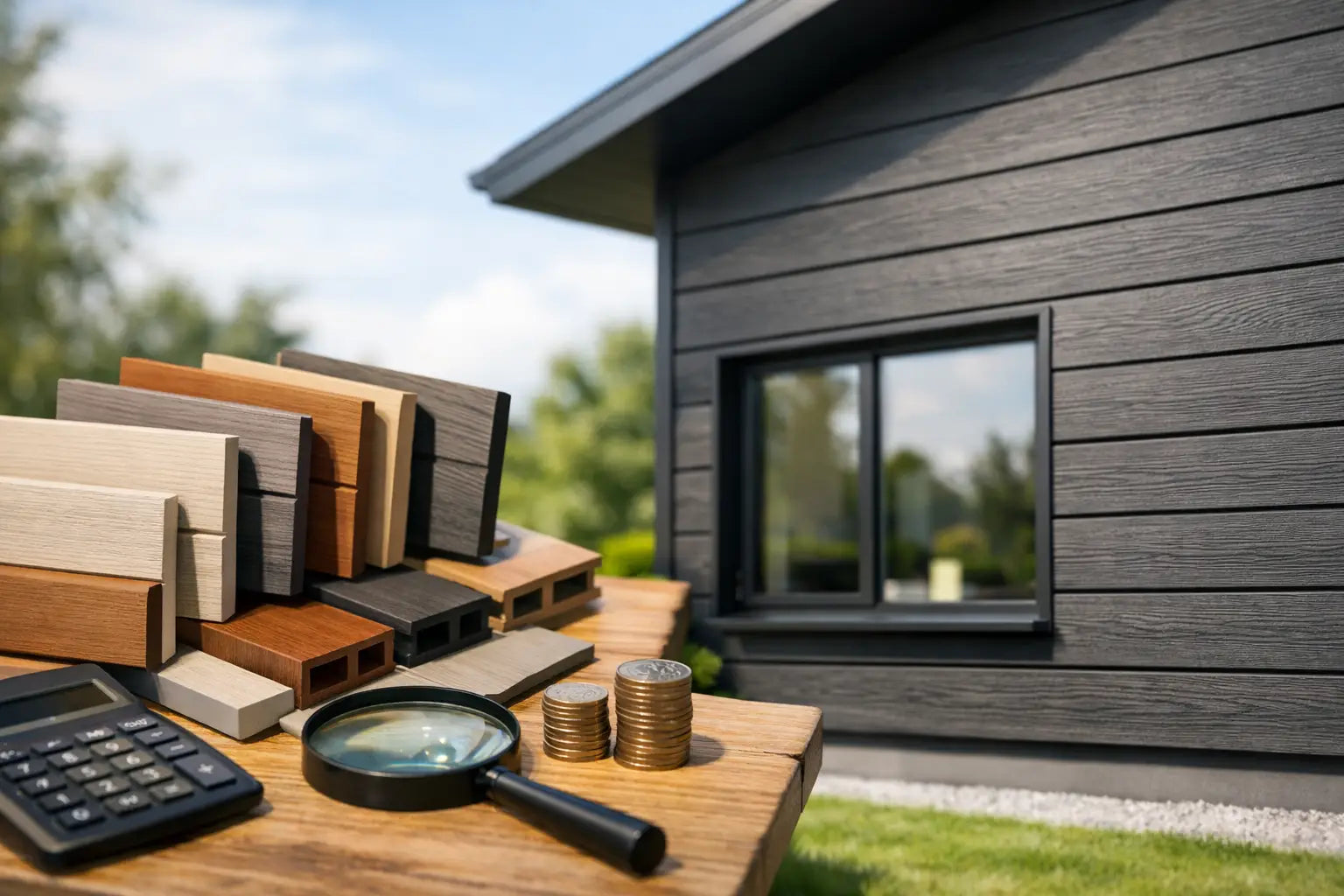
A facade with a warm wood look doesn't have to become a recurring painting job. Those who want to compare composite facade cladding prices will quickly discover that the lowest price per plank doesn't automatically lead to the most economical facade. The real investment lies in the complete system: the panels, the subframe, the fastening, the finishing, and an installation that remains neat for years.
Composite facade cladding is made for homeowners and professionals who want to combine a modern look with low maintenance. The material discolors and grays less quickly than untreated wood, is resistant to moisture, and provides a consistent finish over large facade areas. But composite is not a standard product. Therefore, compare not only a price tag but also what you get for it.
A price per linear meter says little as long as the working width is missing. Overlapping rabbet boards mean that part of the plank disappears from view. The relevant question is: how many square meters of facade do you actually cover with one panel?
First, calculate the net facade area. Measure the width and height of each wall and subtract large windows, doors, and other openings. Then add a reserve of approximately 5 to 10 percent for saw loss, corner finishing, and any selections in color or grain. For a facade with many window openings, slanted edges, or staggered sections, this reserve is often higher than for a straight, closed wall.
You then divide the total material price by the net number of square meters. This allows you to compare systems fairly, even if one supplier offers long, wide rabbet boards and the other shows a lower price for narrower profiles. A slightly more expensive, wider panel can actually be more favorable per finished square meter and also be quicker to install.
A facade consists of more than just visible parts. Those who only budget for the composite planks will almost always face additional costs during installation. A complete quote or shopping cart also includes the subframe, ventilation provisions, starting and ending profiles, corner profiles, fastening clips or screws, and possibly EPDM or other protection behind the cladding.
The visible parts determine a large part of the appearance and the price. Pay attention to the thickness, the working width, the length, the colorfastness, and the surface. A brushed wood structure or a deep relief grain gives a more convincing wood look but can be more expensive than a simple smooth profile.
The type of material also makes a difference. Some composite panels are more solid, others have a hollow core or a protective outer layer. A co-extrusion layer can provide extra protection against stains, moisture, and UV radiation. This can increase the purchase price but is attractive for facades with a lot of sun, rain, or deposits from trees.
You do not mount composite facade cladding directly against a closed wall without an air cavity. Ventilation must be possible behind the panels so that moisture can escape and the facade construction remains dry. This requires a sturdy subframe, sufficient spacers, and openings at the bottom and top.
The choice between wooden battens or aluminum profiles affects the price. Wood can be more favorable to purchase, provided it is suitable for the application and properly protected. Aluminum is dimensionally stable, light, and highly resistant to moisture, but generally requires a higher budget. For a long lifespan and a sleek, modern facade, this difference is often well justifiable.
Corners, window edges, and roof edges determine whether a facade looks professionally finished. These components are often forgotten in a quick price comparison. Always include starting profiles, ending profiles, internal and external corner solutions, and any ventilation profiles.
A system with matching finishing profiles looks calmer than a solution with loose, improvised edge finishes. This is especially visible in modern homes, extensions, and canopies where lines need to run neatly. Therefore, do not choose based solely on the price of the rabbet board, but on the quality of the entire facade system.
Concealed fastening provides a calm facade appearance without visible screw heads. The clips and corresponding screws cost more than a simple visible installation but often yield a better end result. In addition, system fasteners take into account the natural movement of composite due to temperature differences.
If you are an experienced do-it-yourselfer, you can reduce installation costs by installing it yourself. However, work precisely: a flat subframe, the correct center-to-center distance, and sufficient expansion space are essential. For high facades, complex details, or projects where insulation and waterproofing are adjusted, a professional is usually the safer choice. In that case, ask not only for a price per square meter but also what is included in the installation price: preparation, scaffolding, finishing, waste, and any repair work.
Two composite facade panels can look very similar in a product photo, while their performance differs. Therefore, always check the technical specifications. How thick is the panel? What is its working width? Is the profile suitable for vertical, horizontal, or both mounting methods? And what guarantees apply to material and color?
Also pay attention to the color. Dark colors absorb more heat in full sun. As a result, they can expand more than light tones. This does not mean that dark facade cladding is not a good choice, but it does mean that the installation instructions must be followed with extra precision. Allow sufficient space at end faces, connections, and profiles.
The desired appearance also plays a role. Horizontal rabbet boards make a facade appear optically wider and are well suited for a modern, low extension. Vertical panels emphasize height and give a house a slimmer appearance. The installation method, sawing direction, and required finishing can vary per design, and with it, the budget.
Wood may seem cheaper at purchase, but it generally requires periodic cleaning, sanding, staining, or painting. With composite, maintenance is limited to cleaning with water and a soft brush or a suitable cleaning agent. No annual painting means less material, less time, and less chance of procrastination leading to facade deterioration.
This makes composite particularly interesting for facades that are difficult to access, such as high side walls, dormer windows, or facades above a patio canopy. The initial investment is often higher, while the maintenance burden remains lower over the years. For a temporary application or a small budget project, wood may still be suitable. For those seeking a long-lasting neat result, composite is often the more logical choice.
For each supplier, ask for the same basis: net facade area, desired installation method, color, direction of the panels, and the necessary edge finishing. Then compare complete material lists instead of separate "from" prices. An offer that includes clips, profiles, and substructure provides much more clarity than an attractive amount for only the visible parts.
Also check the available lengths. Long panels limit the number of seams but are harder to transport and handle. Shorter panels are more practical for smaller projects and can result in less cutting waste for facades with many interruptions. The best choice therefore depends on the facade design, not just the price per plank.
At WPC Solutions, this system approach is central: combining composite rabbet boards with matching accessories and a correct finish. This makes ordering clearer and prevents you from having to reorder essential parts halfway through the installation.
Before placing your order, take the time to fully draw out one facade section, including corners, windows, and connections. With this preparation, you are not simply buying composite panels, but you are assembling a facade that looks neat from the first day of installation and will continue to do so.