Total: €0,00
Taxes and shipping calculated at checkout

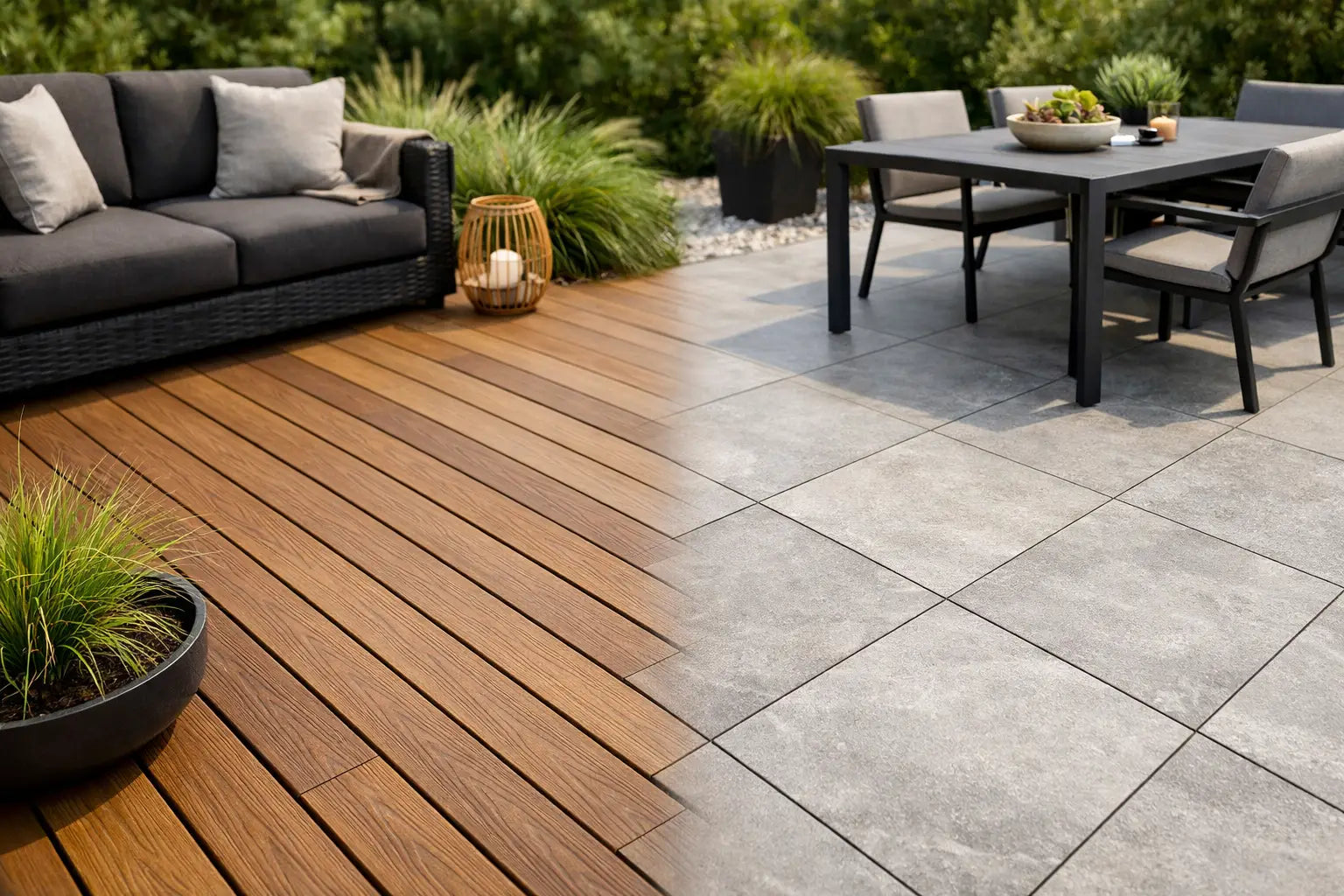
A patio shouldn't just look neat on the day it's built. It should also be pleasant to walk on after a rain shower, match your home, and withstand years of sun, dirt, and intensive use. When choosing between decking boards or ceramic tiles, it's not just about taste. You are choosing a material that determines how much maintenance you perform, how your outdoor space feels, and how flexibly you can make adjustments later.
Composite decking boards and ceramic patio tiles are both strong, low-maintenance options. However, they clearly differ in comfort, installation, appearance, and subsurface. Those who are aware of these differences beforehand can prevent a patio that looks beautiful but is less suitable for daily use.
A composite deck consists of elongated boards with a wood look. The boards are mounted on a supporting structure, creating a slightly raised patio. This gives a warm, modern look and offers space for a neat finish of height differences, cables, or lighting.
Ceramic tiles, on the other hand, form a hard, closed patio surface. They are usually laid on a stable, flat subsurface, for example in a sand-cement bed, on tile pedestals, or on a well-prepared foundation package. The result is sleek, stony, and architectural.
The best choice depends on the ambiance you are looking for, but especially on the technical situation in your garden. Do you have a patio directly adjacent to the house, an existing concrete subsurface, or a place with a height difference? Then the installation method can be decisive.
Those who want to bring warmth into the garden often opt for composite. The grain, board direction, and color provide the character of wood, without annual sanding, staining, or oiling. A deck therefore connects beautifully with wooden facade details, a modern fence or a canopy. By laying the boards lengthwise, you can also make a narrow garden appear optically longer.
Ceramic tiles fit well with a minimalist home, a sleek veranda, or a garden with a lot of stone, stucco, and aluminum. Large formats create tranquility and make a patio look generous. The color and joint are decisive here: a light grey tile looks fresh, while anthracite creates a strong contrast with plants.
Comfort makes the difference on bare feet. Composite generally feels warmer and less hard than ceramic. This is pleasant for a lounge area, swimming pool, or outdoor table where children often play. Ceramic is hard and cool, which can be pleasant on warm days, but feels less comfortable in the evening or in spring and autumn.
Pay attention to sun exposure for both materials. Dark composite boards and dark ceramic tiles can heat up considerably in full sun. On a patio without shade, a lighter color is often a practical choice, especially if you walk barefoot a lot.
Both composite and ceramic require much less attention than untreated wood. However, completely maintenance-free does not exist. Pollen, leaves, grease splatters, and green deposits remain part of outdoor living.
Composite decking boards are periodically cleaned with water, a soft brush, and a suitable cleaner. Regular removal of dirt prevents deposits from accumulating in the structure. Avoid aggressive agents and unnecessarily high pressure from very close up, as this can damage the surface.
Ceramic tiles are very dense and hardly absorb moisture or dirt. Stains from food, drinks, or potting soil are therefore usually easy to remove. The focus is mainly on the joints, edges, and any deposits in a shady spot. For tiles on pedestals, dirt can also get between the joints.
If you want to spend as little time as possible cleaning, both materials have a clear advantage over wood. For a warm look with limited maintenance, composite is strong. For an extremely closed, scratch-resistant surface, ceramic is often the logical candidate.
A composite deck is not a loose floor. Durable installation starts with a stable, well-draining subsurface and a solid frame. The construction must be sufficiently supported, water must be able to drain away, and ventilation under the boards is necessary. This prevents moisture accumulation and keeps the patio neat in the long term.
Especially on an uneven subsurface, a deck offers an advantage. With adjustable pedestals or a carefully constructed framework, a height difference can be relatively well compensated. Also, if you want to keep pipes, drainage, or outdoor lighting out of sight, the space under a deck is practical. Make sure there are accessible points if maintenance is needed on facilities later.
Ceramic tiles require an extremely flat and load-bearing base. A tile that is not fully supported can crack under load. When placed on a sand bed, correct confinement and drainage are essential. For tiles on pedestals, the subsurface is also crucial: it must be stable and distribute the weight well.
For DIY enthusiasts, composite is often straightforward when the substructure is accurately prepared. Tiling sometimes seems simpler, but requires a lot of precision in height, slope, and stability. For large ceramic tiles, professional processing is often advisable, especially for patios with complex edges or a connection to the house.
The price per square meter is a logical starting point, but it doesn't tell the whole story. For composite, you need to factor in sub-beams, clips, edge finishing, foundation, and possibly adjustable pedestals. For ceramic, this includes groundwork, stabilization layer, joint material, glue or pedestals, and cutting work.
Lifespan and maintenance are also part of the total investment. A cheap wooden deck might seem attractive in the short term, but often requires recurring maintenance and possibly earlier replacement. Composite offers a predictable investment in a sleek wood look without painting or oiling. Ceramic is strong and durable, but installation can require more preparation and expertise.
Therefore, always compare complete systems, not just individual boards or tiles. A patio is only as strong as its base and finish. A well-designed edge, correct drainage, and materials that complement each other ultimately yield more than a low material price alone.
Composite is particularly suitable when you want a warm outdoor floor with a modern, consistent wood look. It works well around a canopy, as a garden path, as a raised patio, or in a home where inside and outside should visually merge. For projects where you want to compensate for height differences, a decking construction offers a lot of freedom.
Choose quality boards with a finish that matches the desired appearance: calm and even for a minimalist garden, or with a clear wood structure for more character. Consider in advance the board direction, edge finishing, and any integrated lighting. These details transform a solid patio into an outdoor space that truly feels complete.
Ceramic is strong when you are looking for a flat, hard patio with a distinctly modern look. It is a good choice for an existing, stable subsurface and for outdoor areas that are frequently used for eating, barbecuing, or intensive gardening. Spilled sauces, muddy shoes, and plant pots are usually easy to handle on a dense tiled floor.
For a completely flat transition from living room to patio, ceramic can be visually very powerful. However, choose a tile with sufficient anti-slip value for outdoor use. A smooth tile that works well indoors is not automatically safe outdoors in rain or frost.
Don't start with the color, but with the subsurface, sun exposure, and how you use the patio. Do you want to live outdoors daily on a warm floor with a wood look and a smart solution for height differences? Then composite decking boards are a very attractive choice. If you are looking for a hard, sleek, and closed surface on a stable base, then ceramic offers many advantages.
Also consider the rest of your garden in the decision. A patio gains more appeal when the floor, fence, facade accents, and lighting form a cohesive whole. With a well-chosen composite patio, you create that calm, modern base where you can step outside for years without maintenance taking over your weekend.