Total: €0,00
Taxes and shipping calculated at checkout

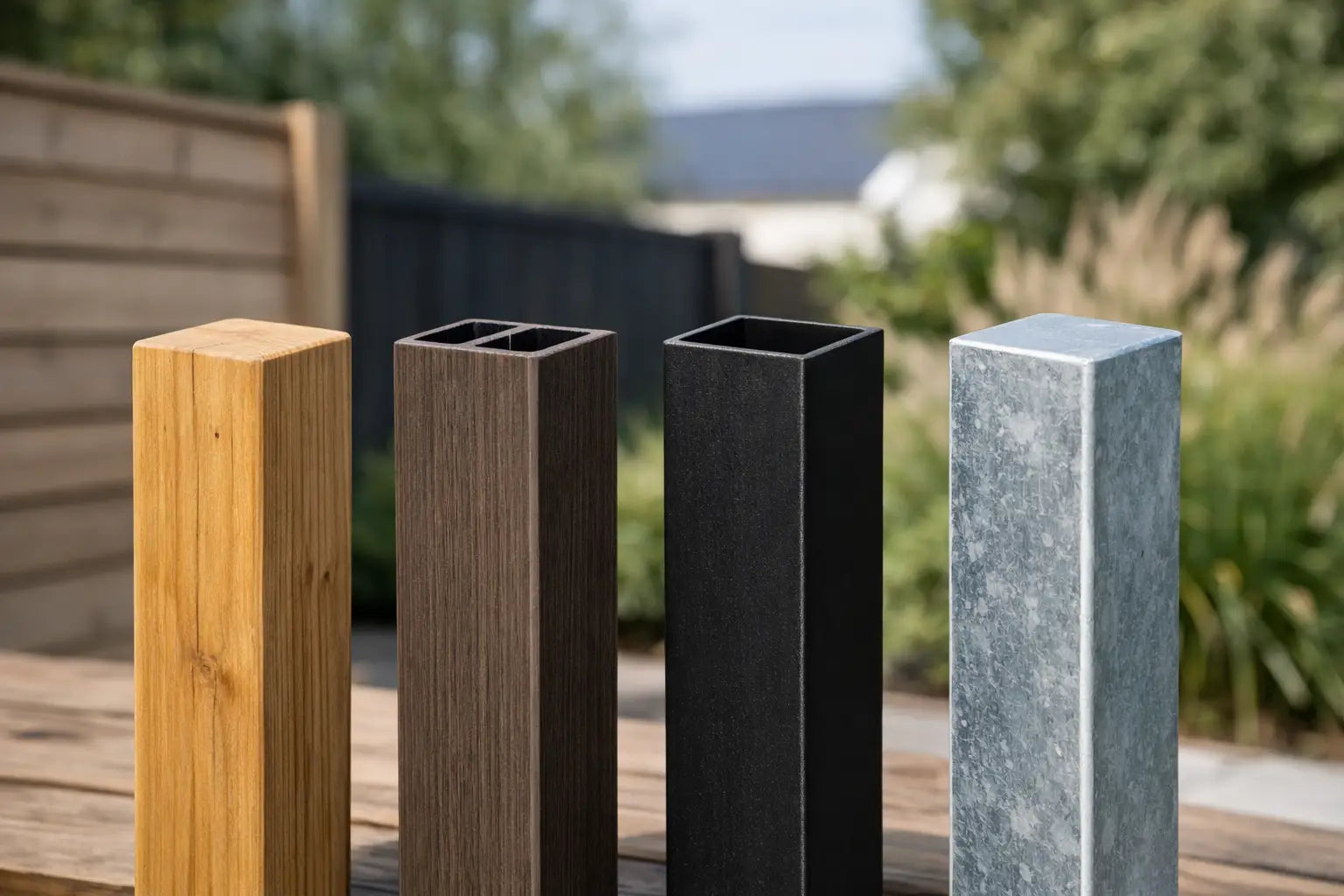
A fence stands or falls with its posts. You can choose the most beautiful screens or composite planks, but if you're wondering which garden posts are right for your fence, it ultimately comes down to sturdiness, lifespan, and a clean finish. This is precisely where people often save money – and you see the consequences later in leaning, play, or unnecessary maintenance.
The right choice depends on three things: the type of fence, the subsoil, and the desired aesthetic. For a light garden partition in a sheltered backyard, you need less heavy posts than for a high boundary fence in an open area exposed to a lot of wind. It also matters whether you are working with loose fence sections, stackable composite planks, or a complete system with matching profiles.
Those primarily looking for convenience and a modern, low-maintenance appearance usually opt for aluminum or composite posts in a system solution. Wooden posts are often still chosen for their lower initial price, but they require more attention and simply have a shorter predictable lifespan. Concrete is strong but looks heavier and doesn't suit every garden.
Wooden garden posts are familiar territory. They are easy to work with and often affordable to purchase. However, that's where the compromise immediately lies. Wood works, can rot at ground level, and requires maintenance or replacement in the long run. For a modern fence with clean lines, this is not always the most logical choice, especially if you want less work.
Concrete posts are strong and stable. They are popular for traditional fences with wooden screens, mainly because they are well resistant to moisture from the ground. The disadvantage is their weight, coarser appearance, and less refined finish. For those who want a minimalist garden, concrete can quickly feel heavy.
Aluminum posts are the smartest choice for many modern fences. They are dimensionally stable, weather-resistant, low-maintenance, and have a sleek appearance. In combination with composite fence sections, you get a system that technically and visually matches well. This not only saves on maintenance but also on ease of installation and the final result.
Composite posts also exist, but they are more often used as a visual component of a system than as a universal solution for every type of fence. The quality and internal structure make a big difference here. For a long-term stable construction, many professionals therefore prefer aluminum supporting parts with composite panels or planks.
With composite fences, you want the post to be as low-maintenance as the rest of the system. Otherwise, the problem merely shifts. If you choose composite planks with a wood look, an aluminum post is often the most logical partner: sleek, durable, and resistant to moisture, temperature fluctuations, and long-term loads.
This is especially important in a climate with wet winters, hot summers, and strong gusts of wind. A post must not only bear the weight but also absorb movement without the fence shifting or rattling. Therefore, it is wise not only to look at the color or profile but also at the structural strength of the post.
For homeowners, this means less hassle in the long run. For landscapers and installation companies, it means a more predictable result and less chance of post-service. This is precisely why complete systems are so strong: all components are coordinated.
A common mistake is to choose a post based on visible height alone. But a fence post must also go deep enough into the ground. As a rule of thumb, about a third of the total post length is underground, although this depends on the soil type, screen height, and wind load.
For a fence about 6 ft high, you usually need longer posts than you initially think. If your garden is on loose sandy soil or in an open environment, extra anchoring is not an unnecessary luxury. The distance between the posts also plays a role. The larger the span, the heavier the load on each post.
The thickness or profile size of the post must match the system. Too light may seem sufficient during installation but often shows movement later. Especially with full privacy fences, the surface catches a lot of wind. Then, extra rigidity is not a detail but a basic requirement.
It's not just the post itself that determines the result. The subsoil is at least as important. In clay soil, a foundation behaves differently than in sand or moist garden soil. A post that is theoretically strong enough can still cause problems in practice if it is not placed deep enough or is insufficiently stabilized.
When placing in concrete, you usually get the most certainty, especially with higher or heavier fences. This takes a little more time in assembly but often results in a much more stable end product. For professionals, this is standard practice. For DIYers, it's tempting to work faster, but this is precisely where doing it right pays off.
Also pay attention to the fence line. A sleek modern boundary fence requires precise alignment, equal center-to-center distances, and posts that are perfectly level. A small deviation at the beginning becomes progressively more pronounced further along.
There are situations where wooden garden posts are still perfectly suitable. For example, for a budget project, a temporary fence, or a more natural garden where weathering can be part of the aesthetic. In such cases, wood is not necessarily wrong, as long as you are honest about its lifespan and maintenance.
In that case, opt for properly treated wood and account for faster wear at the transition from ground to air. This is where problems usually begin. If you want as little maintenance as possible and prefer to invest well once, you are usually better off with aluminum or a complete composite system.