Total: €0,00
Taxes and shipping calculated at checkout

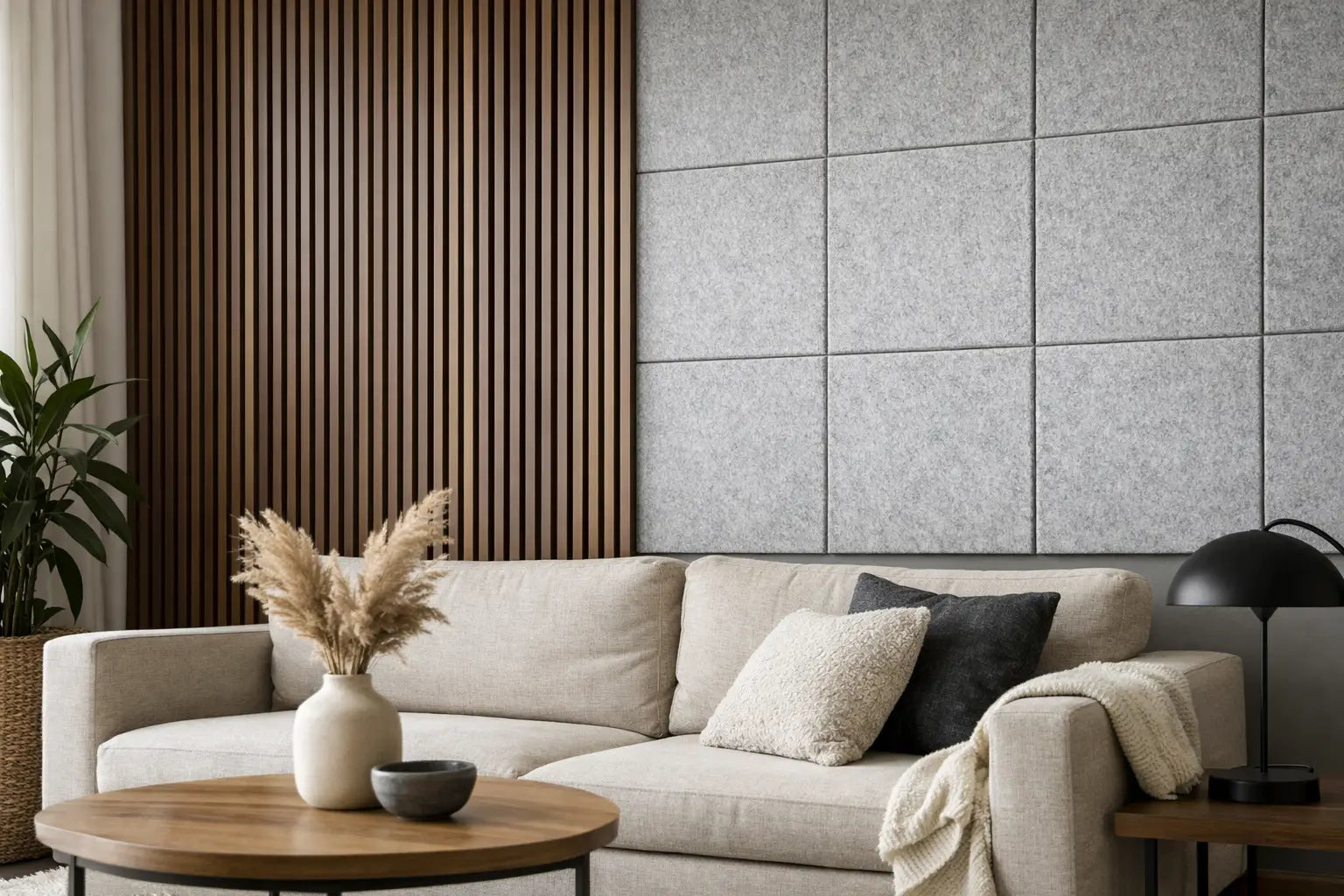
A living room can look sleek and luxurious, yet feel restless. The sound often reveals where things go wrong. Hard floors, large windows, and smooth walls reflect voices, TV sound, and reverberation. That's precisely why acoustic wall panels for the living room are so interesting for those who want more peace without compromising on aesthetics.
Those who mainly think of acoustics sometimes expect a technical solution that looks visibly functional. In practice, that is outdated. Modern panels combine sound dampening with a warm wood look, sleek lines, and a finish that suits a contemporary interior. So you tackle two problems at once - too much reverberation and a wall that still lacks atmosphere.
The living room is rarely acoustically friendly furnished. A sofa, rug, and curtains help, but in many homes, the sound remains harsh. Especially in open living spaces with a kitchen, concrete-look floor, or high ceilings, you hear that immediately. Conversations sound sharper, the TV needs to be louder, and the space feels less relaxed.
Acoustic wall panels remove some of that harshness. They break sound waves and reduce reflection on large flat surfaces. You notice this not only when listening to music or watching TV, but especially in daily use. Less reverberation means a calmer sense of space.
There is nuance to this. Wall panels do not make a living room as quiet as a studio. They are intended to reduce reverberation and improve living comfort. So do not expect complete sound insulation against neighbors or street noise. Other structural solutions are needed for that.
For many homeowners, appearance is just as important as performance. That's logical. A wall panel is fully visible and must match the rest of your interior. That is precisely why wood-look panels are so popular in the living room. They immediately add more depth to a flat wall and make a space warmer without the maintenance that real wood requires.
In a modern interior, dark tones often work powerfully behind a TV cabinet or seating area. They provide contrast and a luxurious appearance. Lighter colors are smart if your living room is compact or if you want to maintain a calm, Scandinavian base. Both choices can work out well - it depends on the light, floor choice, and how much accent you want to make.
The slat division also plays a role. Narrow, regular slats look sleek and architectural. A wider rhythm feels a bit calmer. In a living room where many lines are already present, such as herringbone floors or black window frames, balance is important. Too much contrast makes a space busy. A well-chosen panel brings peace.
The mounting location determines how much difference you hear and see. In many living rooms, the wall behind the sofa is a logical choice. This is usually a large surface, central in the room, and acoustically relevant. Moreover, you can quickly turn it into a real eye-catcher.
The wall behind the TV is also popular. Not only because of the design, but also because this is often where sound directly enters the room. A panel wall behind the TV cabinet provides a neater finish and a more damped overall sound. This effect is especially pleasant if your living room has an open connection to the dining room or kitchen.
Do you have a long, bare side wall? Then there can be a lot of gain there. Large empty surfaces often cause more reverberation than people think. You don't always have to cover that wall completely. A well-positioned partial surface can already make a noticeable difference and keeps the design light.
For smaller living rooms, the rule often applies: less surface, but consciously placed. A complete accent wall can be beautiful, but not necessarily. Sometimes a half-height application or a compact panel surface works better, especially if you don't want to visually shrink the space.
Those who invest in wall finishing want it to look good not only on day one. Maintenance therefore plays a role, especially in a living space that is intensively used. Panels with a durable, low-maintenance finish have a clear advantage here. You maintain the luxurious appearance of wood, but without sanding, varnishing, or hassle.
That makes them practical for families, pet owners, and anyone who wants a sleek living room without extra work. Removing dust is usually easy and the finish remains consistent. This fixed, well-maintained image fits well with a modern living style.
However, pay attention to the difference between appearance and performance. Not every decorative slatted panel is automatically strongly acoustic. The construction of the product, the back layer used, and the way the panel absorbs sound make a real difference. If you buy based on looks alone, you may be disappointed with the effect.
This is a question that is often approached too simply. More panels usually give more acoustic effect, but a living room does not have to become a fully covered space. It's about proportion. In a room with many hard materials, you need more surface area faster than in a living room where textiles, furniture, and soft elements are already present.
A single narrow strip is primarily decorative. A wider application over a main wall is more likely to produce an audible result. Therefore, it is smart to first look at where the reverberation comes from. If sound mainly reflects from one large wall, that's where you'll make the biggest gain.
Professional installers often look at layout, ceiling height, and material use in the rest of the room. The same logic applies to private buyers. Don't just measure the wall, but also assess how the room is used. A living space where a lot of talking takes place sometimes requires something different than a living room that mainly needs to feel calm and visually sleek.
Acoustic panels are attractive for DIY enthusiasts because they relatively quickly give a visible result. A straight wall, good measurements, and a neat finish make the difference. Especially in the living room, every connection stands out, so sloppy work is immediately noticeable.
Installing yourself is an excellent choice if you are handy and work on a flat surface. It becomes more precise with sockets, corners, and transitions to the ceiling or skirting board. Then it pays to plan carefully beforehand. It's not just about attachment, but about a calm final look without small mistakes that will bother you later.
For professionals, speed is often an important advantage. With a good system product, you can work efficiently and create a sleek result that looks immediately marketable for the end customer. That's why more and more professionals are choosing low-maintenance wall solutions that combine aesthetics and practical use.
An industrial living room usually requires depth and contrast. Think of dark panels against light walls, black accents, and clear lines. In a warm modern interior, natural tones often work better. They connect more beautifully with beige, sand, taupe, and soft fabrics.
If you have a lot of daylight, you can be a bit more daring in color or panel width. In a darker living room, it is smarter to prevent the wall from becoming too heavy. Then a lighter wood look or a partial application usually works better. The best result is achieved when acoustics and styling are chosen together, not separately.
The combination with lighting also deserves attention. Grazing light along slatted panels gives extra depth and makes the wall luxurious without excess. You see this effect especially in the evening, when the living room is truly used as a living space.
You don't redecorate a living room because a trend has passed. Therefore, it is wise to look beyond just the first impression. Choose a panel that looks good today, but will still fit your interior years from now. Low-maintenance quality, a consistent finish, and a timeless wood look make the difference.
The same applies to price-conscious buyers. Cheap can seem attractive, but if the finish quickly deteriorates or the installation is disappointing, you will ultimately pay more. A solid system provides more certainty, especially if you value a neat finish and long-lasting comfort. That is precisely why many WPC Solutions customers are looking for a solution that looks beautiful immediately and remains practical in the long term.
Whoever chooses acoustic wall panels in the living room not only chooses less reverberation but also a space that feels more pleasant as soon as you enter. If the panel is correct in material, placement, and appearance, you notice it every day - without extra maintenance and without compromising on style.